
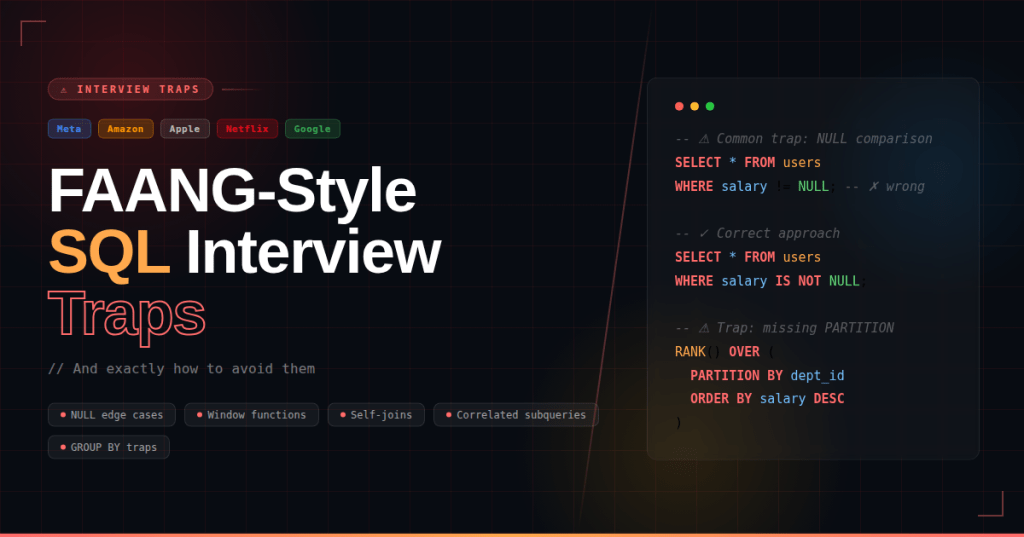
SQL interviews at FAANG (Facebook/Meta, Amazon, Apple, Netflix, Google) are not about syntax. They are designed to test logical thinking, edge cases, execution order, and data correctness at scale. Many strong candidates fail—not because they don’t know SQL, but because they fall into subtle traps.
In this blog, we’ll walk through real FAANG-style SQL traps, why candidates fail them, and how to answer like a senior data engineer or analyst.
1. NOT IN + NULL: The Silent Interview Killer
Question
Find users who never placed an order.
Common (Wrong) Answer
SELECT user_idFROM usersWHERE user_id NOT IN ( SELECT user_id FROM orders);
Why This Fails
If the subquery returns even one NULL, the entire query returns no rows. This is standard SQL behavior—and FAANG interviewers expect you to know it.
FAANG-Safe Answer
SELECT u.user_idFROM users uWHERE NOT EXISTS ( SELECT 1 FROM orders o WHERE o.user_id = u.user_id);
What they’re testing: NULL handling and logical correctness.
2. Top-N Per Group: Ties Break Offers
Question
Find the top 3 salaries per department.
Trap Answer
ROW_NUMBER() OVER (PARTITION BY dept_id ORDER BY salary DESC)
Why This Fails
ROW_NUMBER() ignores ties. If two employees share the same salary, one gets excluded.
Correct Answer
DENSE_RANK() OVER (PARTITION BY dept_id ORDER BY salary DESC)
What they’re testing: Understanding of ranking functions and edge cases.
3. WHERE vs HAVING: Aggregation Logic
Question
Find users with more than 3 orders in 2024.
Wrong Logic
HAVING COUNT(*) > 3 AND order_date >= '2024-01-01'
Correct Answer
SELECT user_idFROM ordersWHERE order_date >= '2024-01-01'GROUP BY user_idHAVING COUNT(*) > 3;
Key rule:
WHEREfilters rowsHAVINGfilters aggregates
4. LEFT JOIN Turned into INNER JOIN
Question
List all users and their last login date (including users who never logged in).
Trap Query
LEFT JOIN logins l ON u.id = l.user_idWHERE l.login_date >= '2024-01-01'
Why This Fails
The WHERE clause removes NULLs—effectively converting the LEFT JOIN into an INNER JOIN.
Correct Answer
LEFT JOIN logins l ON u.id = l.user_id AND l.login_date >= '2024-01-01';
What they’re testing: Join behavior and SQL execution order.
5. MAX(date) with Non-Aggregated Columns
Question
Get the latest order for each user.
Wrong Answer
SELECT user_id, MAX(order_date), amountFROM ordersGROUP BY user_id;
Why This Fails
The amount does not correspond to the max date.
Correct Answer
SELECT user_id, order_date, amountFROM ( SELECT *, ROW_NUMBER() OVER ( PARTITION BY user_id ORDER BY order_date DESC ) rn FROM orders) tWHERE rn = 1;
What they’re testing: Column correlation and data correctness.
6. Date Filtering Trap (Timestamps)
Question
Fetch orders from January 2024.
Trap
WHERE order_date BETWEEN '2024-01-01' AND '2024-01-31'
Correct Answer
WHERE order_date >= '2024-01-01' AND order_date < '2024-02-01';
Why FAANG cares: Production systems store timestamps, not just dates.
7. DISTINCT Is Not a Band-Aid
Question
Count unique active users per day.
Trap
SELECT DISTINCT date, COUNT(user_id)FROM eventsGROUP BY date;
Correct Answer
SELECT date, COUNT(DISTINCT user_id)FROM eventsGROUP BY date;
What they’re testing: Understanding row-level vs aggregate-level DISTINCT.
8. Window Functions in WHERE Clause
Question
Find users with more than 5 orders.
Trap
WHERE COUNT(*) OVER (PARTITION BY user_id) > 5
Correct Answer
SELECT DISTINCT user_idFROM ( SELECT user_id, COUNT(*) OVER (PARTITION BY user_id) cnt FROM orders) tWHERE cnt > 5;
What they’re testing: SQL execution order mastery.
9. Anti-Joins: Correct vs Scalable
Question
Find users with no activity.
Acceptable but Risky
LEFT JOIN events e ON u.id = e.user_idWHERE e.user_id IS NULL;
FAANG-Preferred
WHERE NOT EXISTS ( SELECT 1 FROM events e WHERE e.user_id = u.id);
Why: Better performance and clearer intent at scale.
How FAANG Evaluates SQL Answers
They don’t just look for a working query. They evaluate:
- NULL safety
- Edge-case handling
- Execution order awareness
- Performance at scale
- Clarity of thought
If you explain why your solution is safe, you score higher—even if syntax isn’t perfect.
Final Interview Tip
Before you say “done,” ask yourself:
- What if there are NULLs?
- What if there are ties?
- What if data volume is huge?
That mindset is what FAANG interviews are really testing.







 Srinimf