
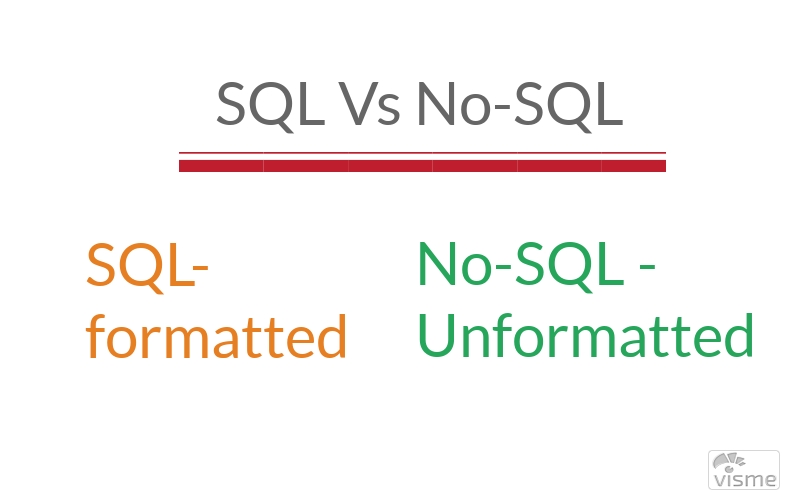
SQL vs NoSQL databases differ mainly in how they structure, store, and query data. SQL databases are **relational** and use predefined tables with fixed schemas, while NoSQL databases are **non-relational** and can store semi-structured or unstructured data with flexible or dynamic schemas. In SQL, the data format is strict and schema-oriented, meaning you must define tables, columns, and data types before inserting records. In NoSQL, data does not have to follow a single fixed format; documents, key-value pairs, wide-column families, or graphs can all be stored without enforcing the same structure for every record. This flexibility makes NoSQL a strong choice for applications where data shapes change frequently or are not known in advance.
Relational Databases
- DDL- data definition language
- DML- data manipulation language
- DCL-data control language
- Strict Schema
- Relational databases
- Query optimization
- Physical Layer
- Began in 1980
Traditional **SQL (relational) databases** include widely used systems such as DB2, Oracle, MySQL, Sybase, and Teradata. These databases are popular with big companies around the world because they offer strong consistency, powerful SQL querying, and reliable support for complex transactions. They are well suited for applications like banking systems, ERP platforms, inventory management, and reporting solutions, where data integrity, strict relationships between tables, and ACID properties are critical. SQL databases also integrate well with existing enterprise tools and analytics platforms, making them a stable choice for long-term, business-critical workloads.
No-SQL data bases
- Non relational
- Distributed
- Schema free
- horizontal scalable
- Began in 2009
New-generation **NoSQL databases** include Column databases, Document databases, and Key-value databases, such as MongoDB, CouchDB, HBase (on Hadoop), and Cassandra. These systems are designed to scale horizontally across many servers, handle very large volumes of data, and support high-speed reads and writes. NoSQL databases are often used for real-time analytics, content management, IoT data, social media feeds, and other large-scale web applications. **When to choose SQL:** – Your data has a clear structure with well-defined relationships. – You need strong consistency, strict transactions, and referential integrity. – You run complex, ad hoc queries and reports using standard SQL. – Your application is more read-intensive and fits well on vertically scaled servers. **When to choose NoSQL:** – Your data is semi-structured or unstructured, or its shape changes frequently. – You need to scale out across many machines and handle high traffic or big data. – You can relax some transactional guarantees in favor of availability and performance. – You want flexible schemas for rapid development and agile application changes. In practice, many modern systems use both SQL and NoSQL together, selecting the right type of database for each part of the application based on data structure, consistency requirements, scalability needs, and performance goals.

You must be logged in to post a comment.